Skip to content

AI character description generator

Give a character more than a list of traits. Turn a short idea into a person you can put in a scene.

Free to try, no account needed. Sign in to keep a result and start a book with 100 welcome credits.

One line in, a person out

Each example starts from a single situation and ends with someone who behaves a particular way. The profile fields are the ones the generator fills for you.

Illustrative example, written for this page

A retired cartographer who secretly redraws the borders of her hometown.

Mara Vale

Mara keeps her cuffs buttoned over ink stains. She remembers every road she has mapped, except the one she erased to protect her brother. She corrects strangers politely and old mistakes in secret.

Character sheet for Mara Vale

Illustrative example, written for this page

A young baker who can hear what people wish for when they taste her bread.

Elin Moss

Elin kneads dough with a silver ring tied to her apron. She is generous with second chances and impatient with silence. Every loaf tells her what a customer wants, but never whether she should help.

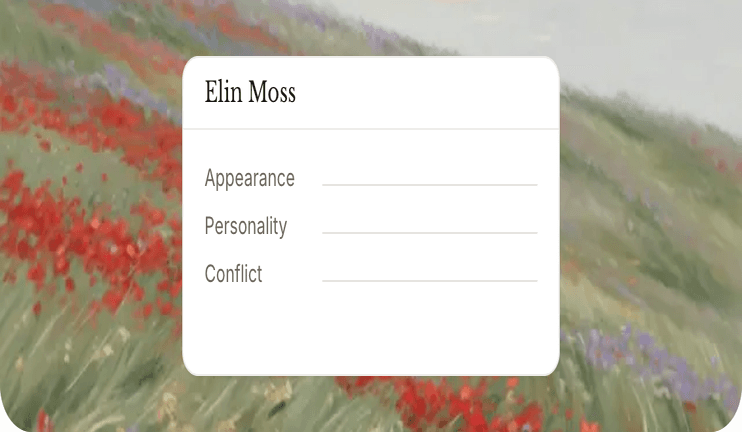
Character sheet for Elin Moss

From a situation to a character you can write

  1. Start with one telling detail

    Describe the character’s role, secret, habit, or situation. You do not need a complete biography.

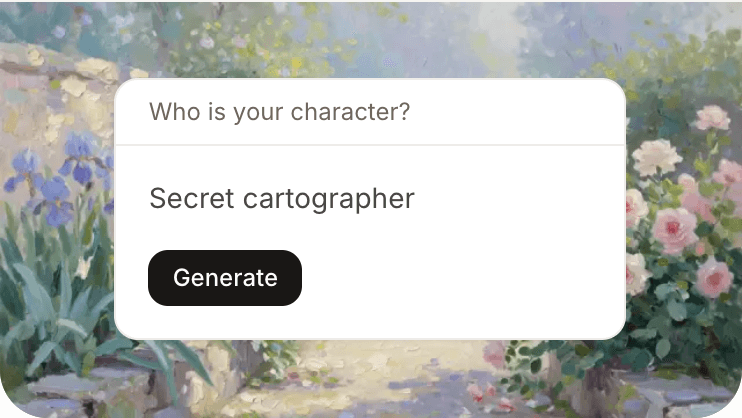
    Character generator prompt for a secret cartographer
  2. Meet your character

    Get a prose description and a coherent set of traits, motivations, and conflicts.

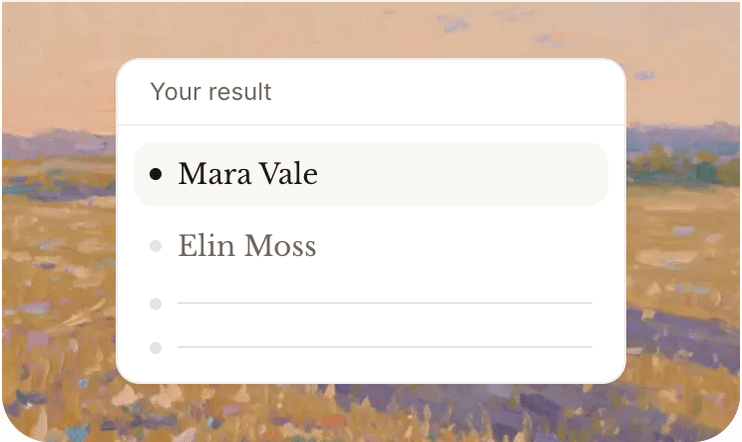
    Character options with Mara Vale selected
  3. Put them in your story

    Edit the description, copy it, or bring the full character draft into a new book.

    Kept character Mara Vale, ready to open a book

What a description needs depends on the role

Your protagonist

You write this person for a whole book, so the description has to hold a contradiction. Give them the want and the belief that fights it.

In practice

Wants to be trusted, keeps the one secret that would earn it.

The opposition

Opposition reads as flat when it has no reason. Write the goal that makes sense from the inside, then let it collide with your protagonist.

In practice

Not cruelty, a debt they fully intend to settle.

Supporting cast

A minor character needs one clear angle, not a biography. Two details and a way of speaking are enough to keep them distinct.

In practice

The neighbor who answers every question with a question.

What makes a description flat, and what fixes it

Three descriptions that hand the reader a verdict, next to the version that shows them the evidence.

Instead of

Brave, loyal, and kind, with a tragic past.

Adjectives are the writer's verdict, and a reader can only take them on trust. An action is evidence, and it can go straight into a scene.

Try

She pays for the stranger behind her in line, then leaves before he can turn around.

Instead of

Tall, with long dark hair and green eyes.

Hair and eye color move nothing. A physical detail earns its line when it also carries a habit, a history, or a worry.

Try

He still ducks through the doorway he has used for eleven years, and still misjudges it.

Instead of

Orphaned young, raised by a cruel uncle, she learned to survive.

Backstory explains who someone used to be. A present want, and the lie told about it, is what drives the next scene.

Try

She keeps a packed bag by the door and tells herself it is only tidiness.

Two characters the generator actually returned

We wrote the premises and ran each through the live generator in the language of this page. The excerpts below are unchanged; the full responses are saved with the requests.

The opposition

Premise

The harbour master who wants the old lighthouse torn down before anyone reads the logbooks kept inside it.

Willem Lark

Description

Willem Lark, the harbour master, stands on the breakwater in a salt-stiffened coat, watching the old lighthouse lean over the channel like an accusation. He has arranged for its demolition before anyone can enter, insisting that the logbooks within are dangerous relics rather than records worth preserving.

Motivation

Willem believes the logbooks contain evidence that past harbour authorities knowingly sent vessels through a treacherous channel, causing deaths the community survived by refusing to discuss. He wants the lighthouse removed so the records cannot reopen old grief, destroy the harbour’s reputation, or turn its present workers into scapegoats for decisions they did not make.

Supporting cast

Premise

The night porter at a hotel where the protagonist keeps returning.

Milo Saye

Description

Milo Saye works the night desk at the hotel, keeping a brass bell polished beside the guest ledger and storing an umbrella behind the counter for anyone caught in the rain. He speaks in a low, courteous murmur, answering questions indirectly with small observations about the hour or the weather, as though giving guests room to tell him why they have come back.

Character description questions

Does this generate character images?

This tool creates written character descriptions. It does not upload, analyze, or generate images.

What does the character profile include?

That depends on the part you choose. A protagonist or the opposition gets a name, a description, appearance, personality, motivation, and conflict. A supporting part gets a name and a short description, since that is all a minor character needs. You can edit every field.

Is it free, and do I need an account?

You can try it without an account a few times a day. Sign in to keep a character or start a book. New accounts get 100 credits, and later generations use credits based on usage. Paid plans are billed through Stripe, and you can cancel any time.

Can I use these characters in a book I sell?

Yes. The characters you create here are yours to publish or sell. The Terms set that out in full.

Can I generate someone who fits a cast I already have?

Yes. Choose the part they play, then describe how they stand in relation to the others. The more of that you give, the closer the result sits to the book you are already writing.

What happens to the character when I continue into a book?

Your edited draft is saved with that book, so it stays in front of you while you write instead of being entered again.

Start your book.From here